A Guyton-based hypothesis for venous congestion
Keywords:
Venous Congestion, Venous Doppler, Venous Excess Ultrasound Score, Guyton, Geometrical Model, Mean systemic filling pressure, venous returnAbstract
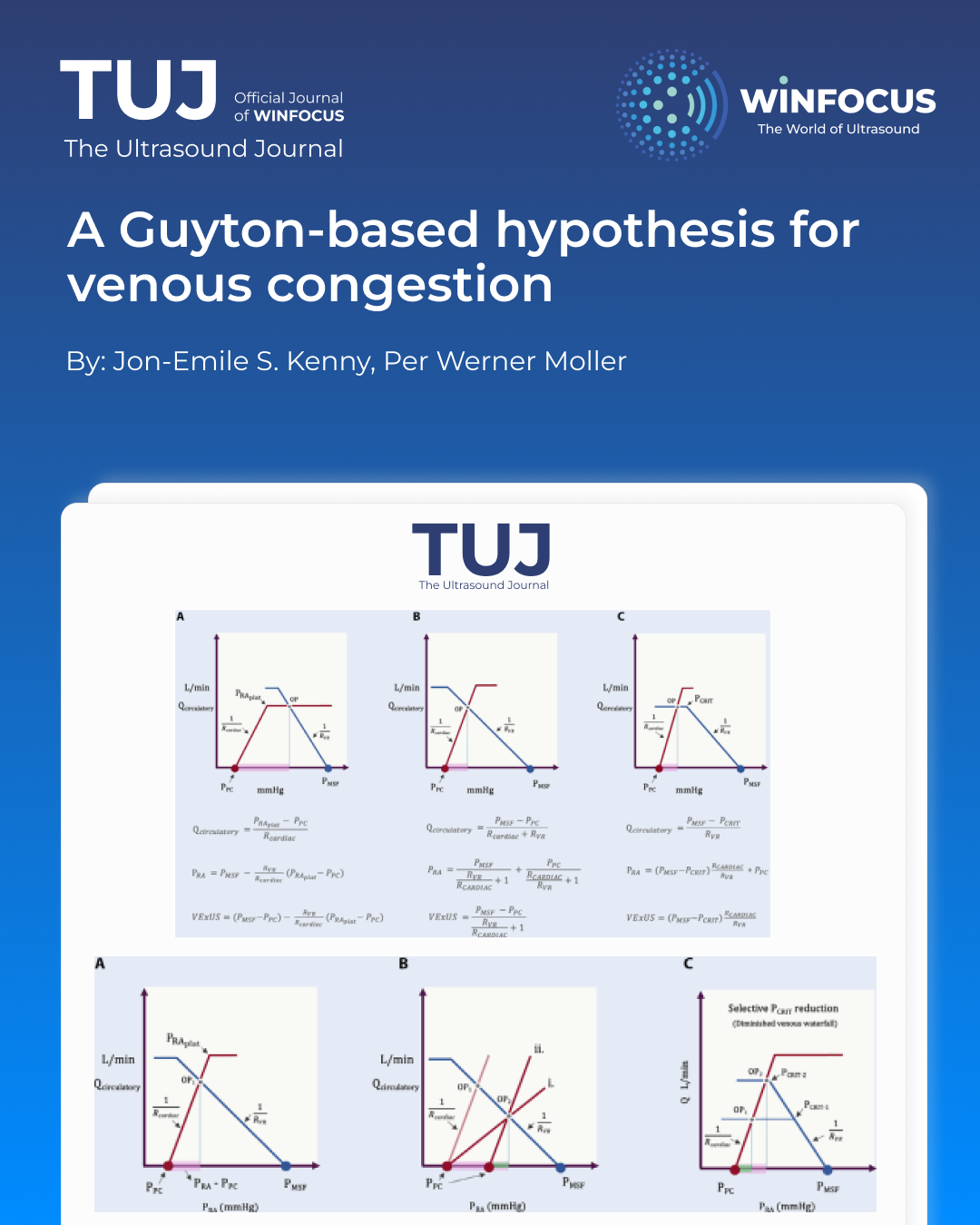
Despite much research and opinion, the underpinnings of venous congestion remain elusive. Many posit that elevated right atrial pressure (PRA) is the primum movens of venous congestion. However, a recent Geometrical model (GM) built from Guyton’s framework advances that PRA is a dependent variable. The GM predicts that: 1.) venous Doppler patterns do not reflect volume state or responsiveness; 2.) venous congestion is not caused by PRA and, in fact, may occur with a low or normal PRA; and 3.) that venous Doppler patterns correspond to transmural rather than absolute PRA.
References
1. Kenny J-ES. Assessing Fluid Intolerance with Doppler Ultrasonography: A Physiological Framework. Medical Sciences. 2022;10(1):12.
2. Kattan E, Castro R, Miralles-Aguiar F, Hernández G, Rola P. The emerging concept of fluid tolerance: A position paper. J Crit Care. 2022;71:154070.
3. Kenny JS, Prager R, Rola P, Haycock K, Basmaji J, Hernández G. Unifying Fluid Responsiveness and Tolerance With Physiology: A Dynamic Interpretation of the Diamond-Forrester Classification. Crit Care Explor. 2023;5(12):e1022.
4. Kenny J-ES. Passive leg raising uncovers venous congestion: dynamic fluid intolerance and the Doppler Starling curve. Critical Care. 2024;28(1):388.
5. Si X, Cao D, Shi R, Song W, Antolini R, Beuzelin M, et al. Fluid responsiveness and changes in venous congestion and lung water during volume expansion in critically ill patients: a multicentre observational study. Crit Care. 2026;30(1):35.
6. Morosanu B, Balan C, Boros C. Incidence, predictability, and outcomes of systemic venous congestion following a fluid challenge in initially fluid-tolerant preload-responders after cardiac surgery: a pilot trial. Crit Care. 2024;28.
7. Balan C, Morosanu B, Fodoroiu A, Dobre V, Dumitrache A, Barbulescu RT, et al. Decoding portal vein pulsatility: hemodynamic determinants in a post-hoc analysis of a prospective observational trial. Annals of Intensive Care. 2025;15(1):81.
8. Ruste M, Reskot R, Schweizer R, Mayet V, Fellahi JL, Jacquet-Lagrèze M. Changes in portal pulsatility index induced by a fluid challenge in patients with haemodynamic instability and systemic venous congestion: a prospective cohort study. Ann Intensive Care. 2024;14.
9. Ruste M, Delas Q, Reskot R, Fellahi JL, Jacquet-Lagrèze M. Relationship between point-of-care ultrasound venous congestion assessment parameters, intravenous pressure, and venous return: a post-hoc analysis of a prospective cohort study. Ultrasound J. 2025;17.
10. Andrei S, Nguyen M, Bouhemad B, Guinot PG. High VExUS grades are linked to cardiac function in general intensive care unit patients. Eur Hear J Acute Cardiovasc Care. 2025;14.
11. Longino A, Martin K, Leyba K, Siegel G, Gill E, Douglas IS, et al. Correlation between the VExUS score and right atrial pressure: a pilot prospective observational study. Crit Care. 2023;27(1):205.
12. Utrilla-Alvarez JD, Gopar-Nieto R, García-Cruz E. Assessing the venous system: correlation of mean systemic filling pressure with the venous excess ultrasound grading system in cardiac surgery. Echocardiography. 2023;40.
13. Kenny JS, Werner Moller P. Venous congestion and the geometry of Guyton. Ann Intensive Care. 2025;15(1):166.
14. Kenny J-ES, Prager R, Haycock K. The elusive relationship between cardiac filling and fluid responsiveness. Critical Care. 2024;28(1):83.
15. Pierre-Grégoire G. VExUS score: optimizing its use in perioperative and critical care management. Crit Care. 2025;29(1):472.
16. Rola P, Souligny WB, Haycock K, Spiegel R, Denault A. VExUS and right ventricular to pulmonary artery uncoupling. Critical Care. 2025;30(1):56.
17. Kenny J-ES, Moller PW. The venous excess ultrasound score (VExUS) and the mean systemic filling pressure. Echocardiography. 2024;41(1):e15727.
18. Beaubien-Souligny W, Rola P, Haycock K, Bouchard J, Lamarche Y, Spiegel R, et al. Quantifying systemic congestion with Point-Of-Care ultrasound: development of the venous excess ultrasound grading system. The ultrasound journal. 2020;12(1):1-12.
19. Spiegel R, Teeter W, Sullivan S, Tupchong K, Mohammed N, Sutherland M, et al. The use of venous Doppler to predict adverse kidney events in a general ICU cohort. Critical Care. 2020;24(1):1-9.
20. Andrei S, Nguyen M, Bouhemad B, Guinot P-G. High VExUS grades are linked to cardiac function in general intensive care unit patients. European Heart Journal Acute Cardiovascular Care. 2024;14(1):24-30.
21. Kenny JS, Werner Moller P. The inferior vena cava for determining volume status: proceed with caution. Cjem. 2024;26(3):214-5.
22. Kenny J-ES. A framework for heart-lung interaction and its application to prone position in the acute respiratory distress syndrome. Frontiers in Physiology. 2023;14:1230654.
23. Parkin WG, Leaning MS. Therapeutic control of the circulation. J Clin Monit Comput. 2008;22.
24. Werner-Moller P, Heinisch PP, Hana A, Bachmann KF, Sondergaard S, Jakob SM, et al. Experimental validation of a mean systemic pressure analog against zero-flow measurements in porcine VA-ECMO. Journal of Applied Physiology. 2022;132(3):726-36.
25. Jacobsohn E, Chorn R, O'Connor M. The role of the vasculature in regulating venous return and cardiac output: historical and graphical approach. Can J Anaesth. 1997;44(8):849-67.
26. Shippy CR, Appel PL, Shoemaker WC. Reliability of clinical monitoring to assess blood volume in critically ill patients. Critical care medicine. 1984;12(2):107-12.
27. Muñoz F, Born P, Bruna M, Ulloa R, González C, Philp V, et al. Coexistence of a fluid responsive state and venous congestion signals in critically ill patients: a multicenter observational proof-of-concept study. Crit Care. 2024;28(1):52.
28. Morosanu B, Balan C, Boros C, Dazzi F, Wong A, Corradi F, et al. Incidence, predictability, and outcomes of systemic venous congestion following a fluid challenge in initially fluid-tolerant preload-responders after cardiac surgery: a pilot trial. Critical Care. 2024;28(1):339.
29. Kenny J-ÉS, Prager R, Rola P, Haycock K, Gibbs SO, Johnston DH, et al. Simultaneous Venous-Arterial Doppler Ultrasound During Early Fluid Resuscitation to Characterize a Novel Doppler Starling Curve: A Prospective Observational Pilot Study. Journal of Intensive Care Medicine. 2024:08850666231224396.
30. Eskesen T, Wetterslev M, Perner A. Systematic review including re-analyses of 1148 individual data sets of central venous pressure as a predictor of fluid responsiveness. Intensive care medicine. 2016;42(3):324-32.
31. Mekontso Dessap A, AlShamsi F, Belletti A, De Backer D, Delaney A, Møller MH, et al. European Society of Intensive Care Medicine (ESICM) 2025 clinical practice guideline on fluid therapy in adult critically ill patients: part 2-the volume of resuscitation fluids. Intensive Care Med. 2025;51(3):461-77.
32. Kenny J-ES, Werner Moller P. The meaning of volume responsiveness and its relationship to venous return. American Journal of Physiology-Heart and Circulatory Physiology. 2023;325(6):H1461-H2.
33. Glantz SA, Parmley WW. Factors which affect the diastolic pressure-volume curve. Circ Res. 1978;42(2):171-80.
34. Brecher GA. Cardiac Variations in Venous Return Studied With a New Bristle Flowmeter. American Journal of Physiology-Legacy Content. 1954;176(3):423-30.
35. Prager R, Pupulin S, Chakera H, Saha R, Orozco N, Kenny JE, et al. The VTI-VeXUS Index in Septic Shock: An Exploratory Proof-of-Concept Observational Study of a Novel Hemodynamic Parameter. J Clin Med. 2025;14(16).
36. Prager R, Pratte M, Kenny JE, Rola P. A Wireless, Wearable Carotid Doppler Ultrasound Aids Diagnosis and Monitoring of Pericardial Tamponade: A Case Report. Crit Care Explor. 2023;5(5):e0911.
37. Kenny JS, Moller PW. Venous waterfall and venous congestion. Intensive Care Med Exp. 2026;14(1).
38. Castro R, Kattan E, Retamal J, Hernández G, Pinsky MR. Venous congestion from a vascular waterfall perspective: reframing congestion as a dynamic Starling resistor phenomenon. Intensive Care Med Exp. 2025;13(1):119.
39. Fessler HE. Effects of CPAP on venous return. J Sleep Res. 1995;4(S1):44-9.
40. Kenny J-ES, Prager R, Rola P, McCulloch G, Eibl JK, Haycock K. The effect of gravity-induced preload change on the venous excess ultrasound (VExUS) score and internal jugular vein Doppler in healthy volunteers. Intensive Care Medicine Experimental. 2023;11(1):19.
41. Kenny J-ES, Rola P, Prager R, Haycock K. Jugular Venous Doppler Ultrasound as a Non-Invasive Window to Right Heart Hemodynamics: A Narrative Review and Future Perspective. Therapeutic Advances in Pulmonary and Critical Care Medicine. 2025;20:29768675251359700.
Downloads
Published
Issue
Section
License
Copyright (c) 2026 Jon-Émile S. Kenny, Per Werner Möller (Author)

This work is licensed under a Creative Commons Attribution-NonCommercial 4.0 International License.
This is an Open Access article distributed under the terms of the Creative Commons Attribution License (https://creativecommons.org/licenses/by-nc/4.0) which permits unrestricted use, distribution, and reproduction in any medium, provided the original work is properly cited.
Authors retain the copyright for their published work. No formal permission will be required to reproduce parts (tables or illustrations) of published papers, provided the source is quoted appropriately and reproduction has no commercial intent.
How to Cite