Post-insertion outcomes of ultrasound-guided versus landmark peripheral intravenous catheters: a systematic review and meta-analysis
Keywords:
peripheral intravenous catheter, ultrasound-guided, landmark, difficult intravenous access (DIVA), catheter failure, dwell time, extravasation, systematic review, meta-analysisAbstract
Background: Ultrasound-guided (USG) peripheral intravenous catheter (PIVC) insertion improves cannulation success, particularly in patients with difficult intravenous access. Whether USG also improves post-insertion outcomes, including catheter failure, dwell time, and complications, remains uncertain.
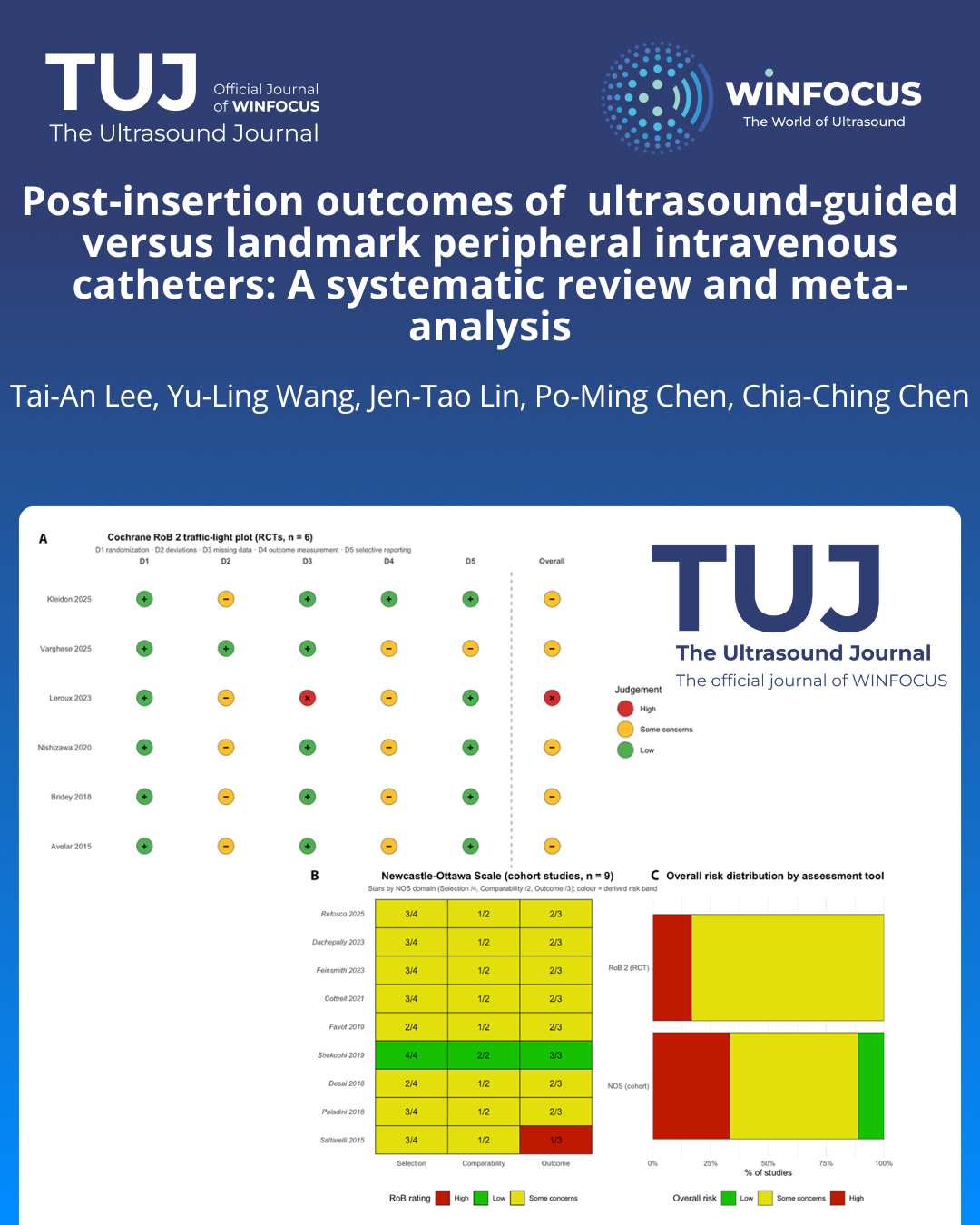
Methods: We conducted a systematic review and meta-analysis of randomized controlled trials and comparative cohort studies comparing USG with landmark-guided PIVC insertion and reporting at least one post-insertion outcome. PubMed, Embase, Cochrane CENTRAL, and CINAHL were searched from January 2000 to March 2026. Risk of bias was assessed using RoB 2 and the Newcastle-Ottawa Scale. Random-effects meta-analysis used the DerSimonian-Laird estimator; REML with Hartung-Knapp-Sidik-Jonkman adjustment was performed as a post-hoc sensitivity analysis because few studies contributed to pooled outcomes.
Results: Fourteen studies (5 randomized trials, 9 cohort studies; 78,209 participants) were included. Catheter failure did not differ significantly between USG and landmark groups (k = 4; RR 1.23, 95% CI 0.99–1.51; p = 0.056), although the estimate was sensitive to model choice and exclusion of the largest study. Dwell time and extravasation were not pooled because of substantial heterogeneity (I² = 91.9% and 95.7%, respectively). Infiltration also showed no significant difference (k = 2; RR 0.68, 95% CI 0.12–3.83). Several studies reporting favorable USG outcomes were substantially confounded by systematic differences in catheter length or material between groups.
Conclusions: Current evidence does not demonstrate a consistent post-insertion advantage of USG over landmark PIVC placement. Reported benefits in some studies may reflect catheter-specification differences rather than ultrasound guidance itself. Larger, well-controlled trials are needed.
References
1. Alexandrou E, Ray-Barruel G, Carr PJ, Frost SA, Inwood S, Higgins N, et al. Use of Short Peripheral Intravenous Catheters: Characteristics, Management, and Outcomes Worldwide. J Hosp Med. 2018;13(5).
2. O'Grady NP, Alexander M, Burns LA, Dellinger EP, Garland J, Heard SO, et al. Guidelines for the prevention of intravascular catheter-related infections. Am J Infect Control. 2011;39(4 Suppl 1):S1-34.
3. Nickel B, Gorski L, Kleidon T, Kyes A, DeVries M, Keogh S, et al. Infusion Therapy Standards of Practice, 9th Edition. J Infus Nurs. 2024;47(1S Suppl 1):S1-S285.
4. Egan G, Healy D, O'Neill H, Clarke-Moloney M, Grace PA, Walsh SR. Ultrasound guidance for difficult peripheral venous access: systematic review and meta-analysis. Emerg Med J. 2013;30(7):521-6.
5. Avelar AF, Peterlini MA, da Luz Goncalves Pedreira M. Ultrasonography-Guided Peripheral Intravenous Access in Children: A Randomized Controlled Trial. J Infus Nurs. 2015;38(5):320-7.
6. van Loon FHJ, Buise MP, Claassen JJF, Dierick-van Daele ATM, Bouwman ARA. Comparison of ultrasound guidance with palpation and direct visualisation for peripheral vein cannulation in adult patients: a systematic review and meta-analysis. Br J Anaesth. 2018;121(2):358-66.
7. Fields JM, Dean AJ, Todman RW, Au AK, Anderson KL, Ku BS, et al. The effect of vessel depth, diameter, and location on ultrasound-guided peripheral intravenous catheter longevity. Am J Emerg Med. 2012;30(7):1134-40.
8. Elia F, Ferrari G, Molino P, Converso M, De Filippi G, Milan A, et al. Standard-length catheters vs long catheters in ultrasound-guided peripheral vein cannulation. Am J Emerg Med. 2012;30(5):712-6.
9. Malik A, Dewald O, Gallien J, Favot M, Kasten A, Reed B, et al. Outcomes of Ultrasound Guided Peripheral Intravenous Catheters Placed in the Emergency Department and Factors Associated with Survival. Open Access Emerg Med. 2023;15:177-87.
10. Avelar AF, Peterlini MA, da Pedreira ML. [Assertiveness and peripheral intravenous catheters dwell time with ultrasonography-guided insertion in children and adolescents]. Rev Esc Enferm USP. 2013;47(3):539-46.
11. Kleidon TM, Schults J, Paterson R, Rickard CM, Ullman AJ. Comparison of ultrasound-guided peripheral intravenous catheter insertion with landmark technique in paediatric patients: A systematic review and meta-analysis. J Paediatr Child Health. 2022;58(6):953-61.
12. Kleidon TM, Schults JA, Royle RH, Gibson V, Ware RS, Andresen E, et al. First-Attempt Success in Ultrasound-Guided vs Standard Peripheral Intravenous Catheter Insertion: The EPIC Superiority Randomized Clinical Trial. JAMA Pediatr. 2025;179(3):255-63.
13. Kleidon TM, Schults J, Rickard C, Ullman AJ. Ultrasound-guided PIVC insertion: a randomised controlled trial protocol. Br J Nurs. 2023;32(14):S22-S8.
14. Desai K, Vinograd AM, Abbadessa MKF, Chen AE. Longevity and Complication Rates of Ultrasound Guided Versus Traditional Peripheral Intravenous Catheters in a Pediatric Emergency Department. J Assoc Vasc Access. 2018;23(3):149-154.
15. Nishizawa T, Matsumoto T, Todaka T, Sasano M, Kitagawa H, Shimabuku A. Nurse-Performed Ultrasound-Guided Technique for Difficult Peripheral Intravenous Access in Critically Ill Patients: A Randomized Controlled Trial. J Assoc Vasc Access. 2020;25(2):34-39.
16. Bridey C, Thilly N, Lefevre T, Maire-Richard A, Morel M, Levy B, et al. Ultrasound-guided versus landmark approach for peripheral intravenous access by critical care nurses: a randomised controlled study. BMJ Open. 2018;8(6):e020220.
17. Varghese S, Ranjit T. Ultrasound-Guided vs Landmark Peripheral IV Cannulation in the Pediatric ED: A Randomized Controlled Trial. Int J Med Public Health. 2025;15(4):1880-1885.
18. Leroux S, Deaner T, Wasser T, Huey C, Carr B, Howard A, et al. The Impact of Peripheral Intravenous Catheter Insertion Technique and Catheter-to-Vein Ratio on Postinsertion Failure. J Emerg Med. 2023;64(5):564-73.
19. Feinsmith SE, Amick AE, Feinglass JM, Sell J, Davis EM, Spencer TR, et al. Performance of peripheral catheters inserted with ultrasound guidance versus landmark technique after a simulation-based mastery learning intervention. J Vasc Access. 2023;24(4):630-8.
20. Shokoohi H, Boniface KS, Kulie P, Long A, McCarthy M. The Utility and Survivorship of Peripheral Intravenous Catheters Inserted in the Emergency Department. Ann Emerg Med. 2019;74(3):381-90.
21. Cottrell JT, Chang T, Baird J, Barreras J, Elkhunovich MA. Ultrasound-guided placement of peripherally inserted intravenous catheters increase catheter dwell time in children. J Vasc Access. 2021;22(2):189-93.
22. Dachepally R, Garcia AD, Liu W, Flechler C, Hanna WJ. Assessing the utility of ultrasound-guided vascular access placement with longer catheters in critically ill pediatric patients. Paediatr Anaesth. 2023;33(6):460-5.
23. Paladini A, Chiaretti A, Sellasie KW, Pittiruti M, Vento G. Ultrasound-guided placement of long peripheral cannulas in children over the age of 10 years admitted to the emergency department: a pilot study. BMJ Paediatr Open. 2018;2(1):e000244.
24. Refosco M, Mazza A, Divisic A, Binotto D, Zamberlan S, Schiavon B, et al. Comparison of peripheral cannula outcomes, ultrasound-guided placement of deep veins versus blind insertion of superficial veins in children aged 0-18 years: A retrospective study. J Vasc Access. 2025;26(5):1476-81.
25. Favot M, Gallien J, Malik A, Kasten A, Wells R, Ehrman R. Contrast Extravasation as a Complication of Emergency Nurse-Performed Ultrasound-Guided Peripheral Intravenous Catheter Placement. J Emerg Nurs. 2019;45(5):512-6.
26. Saltarelli NA, VanHouten J, Boyd J, Rupp J, Ferre RM. Infiltration Rates Are Similar in Ultrasound-Guided and Traditionally Placed Peripheral IVs in Admitted Emergency Department Patients With Difficult IV Access. Ann Emerg Med. 2015;66(4 Suppl):S137.
27. Stolz LA, Stolz U, Howe C, Farrell IJ, Adhikari S. Ultrasound-guided peripheral venous access: a meta-analysis and systematic review. J Vasc Access. 2015;16(4):321-6.
28. van Loon FHJ, Korsten HHM, Dierick-van Daele ATM, Bouwman ARA. The impact of the catheter to vein ratio on peripheral intravenous cannulation success, a post-hoc analyses. PLoS One. 2021;16(5):e0252166.
29. Pandurangadu AV, Tucker J, Brackney AR, Bahl A. Ultrasound-guided intravenous catheter survival impacted by amount of catheter residing in the vein. Emerg Med J. 2018;35(9):550-5.
30. Guyatt GH, Oxman AD, Vist GE, Kunz R, Falck-Ytter Y, Alonso-Coello P, et al. GRADE: an emerging consensus on rating quality of evidence and strength of recommendations. BMJ. 2008;336(7650):924-6.
Downloads
Additional Files
Published
Issue
Section
License
Copyright (c) 2026 Tai-An Lee, Yu-Ling Wang, Jen-Tao Lin, Po-Ming Chen, Chia-Ching Chen (Author)

This work is licensed under a Creative Commons Attribution-NonCommercial 4.0 International License.
This is an Open Access article distributed under the terms of the Creative Commons Attribution License (https://creativecommons.org/licenses/by-nc/4.0) which permits unrestricted use, distribution, and reproduction in any medium, provided the original work is properly cited.
Authors retain the copyright for their published work. No formal permission will be required to reproduce parts (tables or illustrations) of published papers, provided the source is quoted appropriately and reproduction has no commercial intent.
How to Cite